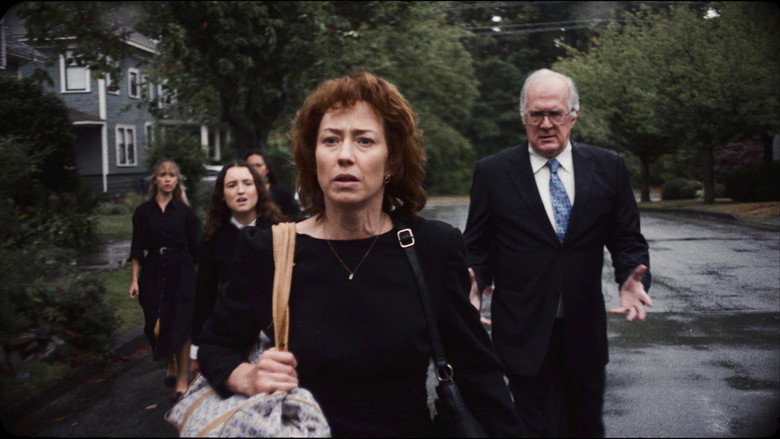
Rita is entranced by the mesmeric Leader and renounces her family to embrace the world of the enigmatic Harmonia commune. Her daughters Ella and Jo put everything on the line to infiltrate the cult and bring their mother home. Yet, once immersed in the commune, they find themselves inexorably drawn into the Leader’s labyrinthine web of psycho-spiritual manipulation.
When we experience unrelenting pain and anguish in our lives, it often seems impossible to escape such trying circumstances. Every day becomes an unceasing exercise in despair, disillusionment and hopelessness, prompting us to wonder whether carrying on is worth it. And such are the ordeals of a distraught middle-aged New Jersey woman in the early 1980s in this new fact-based drama from writer-director Guy Nattiv. Drawing on the experiences of the filmmaker’s grandmother, this offering follows the troubled life of Rita Cooper (Carrie Coon), a childhood Holocaust survivor who struggles to cope with feelings and memories that she simultaneously battles to recall and forget. The married mother of two works lives a rather ordinary life, working as an assistant bank manager and caring for her ailing and aging father, Lenny (Ken Kramer), the only other member of her family to survive the tragedy she’s haunted by. She generally feels like life is pointless and disempowering, despite being surrounded by her loving husband, Reuben (Tracy Letts), and her adoring daughters, Jo (Odessa Young) and Ella (Bella Ramsey). But life takes an unexpected turn, seemingly for the better, when Rita has a chance encounter with Ricki King (Lily James), the leader of an all-women’s group aimed (at least ostensibly) at helping her followers heal themselves, take back their power and live life in personal fulfillment. Rita is understandably intrigued and begins engaging with the organization on a regular basis. But, as she increasingly leaves her family behind, Reuben, Jo and Ella become worried that they’re losing their wife and mother – and with good reason: Ricki’s organization turns out to be a cult, one that uses guilt, manipulation and financial exploitation to control the behavior of its followers, driving wedges between them and those who love them. What’s more, a group that initially promises transformation, empowerment and overcoming personal trauma turns out to be a nightmare, one in which all of those aspirations are taken away when members don’t follow their leader’s dictates. And, when Rita abandons her family and moves into a remote commune established by Ricki and her disciples, serious concerns arise for her emotional well-being and her relationships with those who once meant so much to her. While Rita’s suffering is undeniable and the lure of finding relief from it is enticing, she falls in with a crowd that doesn’t have her best interests at heart, as can certainly happen with predatory organizations like this. At the same time, though, as this story progresses, the narrative begins giving in to sensationalism, undercutting the credibility of the film’s cautionary tale message. That’s unfortunate, because the picture thus overstates its case, distorting the nature of groups like this that promote alternative spirituality, New Age thought and beneficial virtues such as those initially espoused here. And, as one who has spent considerable time with well-meaning organizations like this, I can honestly say that this exaggerated portrayal shouldn’t be taken as gospel. Yes, there may indeed be some agenda-driven groups like this out there, as brilliantly portrayed in offerings like “Ticket to Heaven” (1981), but this offering tends to skew that viewpoint, despite its factual roots in this particular story. The film truly appears to have its heart in the right place, but its presentation progressively moves in the direction of worst case scenario after its sensitively depicted opening act, especially since it’s unclear which events in this narrative have been fictionalized for dramatic effect. To its credit, this release features several fine performances from James, Coon, and, especially, Ramsey, along with a hauntingly beautiful score and gorgeous cinematography. However, the script could stand to have some of its rhetoric toned down, not to mention a better back story to fill in some seemingly significant gaps, despite a preponderance of flashbacks to try and do so. Sadly, the vulnerable among us are easy prey for those seeking to take advantage of them, and “The Liberation” provides a helpful reminder of that danger. It’s unfortunate, though, that, in overplaying its message, it weakens the very warning it’s trying to convey.